



A steering committee can be an effective mechanism for keeping your delivery on track. It can generate key decisions you need to keep moving, and be a source for extra support. It can also unintentionally create inefficiency, taking up valuable time in calendars with little to show for it. Consider these for your steering committee to help make sure you are getting the most of your and your stakeholders’ time.
Do you really need a steering committee?
Like just about everything, a steering committee comes with a regular cost. The benefit of a steering committee to the project and organisation must outweigh these costs. If there are few decisions to be made regularly, consider engaging leaders ad-hoc for support and keep your stakeholders informed through other regular reporting channels. They will appreciate your consideration of their time and it will free you up to put more time into putting runs on the board.
Don’t neglect the administration
If a steering committee is indeed appropriate, put the right amount of polish on the proceedings to demonstrate your consideration of stakeholders’ time and your respect for the work at hand. This includes:
- Distributing the content packs two days in advance
- Attendance
- Minutes
- Action items
For the attendance, minutes, and action items, MS Teams is useful for this. It can track attendance for you, and if your committee has agreed to recordings, you can use the recording to compile the minutes and action items. If recording is not agreed or appropriate, your sponsor may have an executive asssistant who can capture minutes for the team. Don’t try to be a hero and both facilitate a steering committees and capture minutes / actions yourself during the meeting. You simply won’t be able to do both in the depth required for a good outcome.
If you treat the proceedings with care and respect, your committee members will too.
Control the attendee list
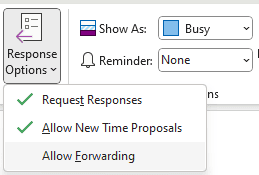
Don’t let your steering committee evolve from a small, focused, and efficient team to a mass gathering of 25-odd sporadic attendees with vague responsibilities. Help maintain clear roles and reasons for participation by turning off ‘Allow Forwarding’ in MS Outlook. Under the Meeting tab, and Response Options, remove the default check mark as below. If someone wants another person to attend, they can speak with the facilitator (you) and you can extend the invitation if needed. This way you make the most of everyone’s time and keep sharp clarity for reasons of attendance.
Shift mindsets from oversight to accountability
If you see the steering committee as a regular check-in to give stakeholders a good impression on the progress you are making, you are missing valuable opportunites to have risks and issues addressed proactively by influential stakeholders.
Sometimes, when people get an invitation to be a member of a steering committee, they see it only as an opportunity to give oversight and otherwise be seen as an important person in the organisation. They may think it is enough to show up, watch a few slides (possibly while multitasking on something else) and perhaps chime in occasionally with approval. In this way it is merely a report presentation, and not a good use of their or your time.
Instead, you will get the best outcome if you can establish a mindset with your committee members where they are each accountable for the performance of a function that aligns with their role. For example, the Human Resources GM on your committee is accountable for the hiring and training deliverables, etc. They are not involved in the day-to-day, but they are across the progress, risks, and issues, and are in an influential position to make adjustments within their part of the organisation to get a good outcome. Because they have accountability they are incentivised to work with you and act on these proactively. Both their part of the business and your project will benefit.
Establish a mindset of accountability amongst members of the steering committee at the outset, through one-on-one conversations. A mutually beneficial arrangement is in everyone’s interest. You will make them look like stars and catalysts for successful change in the organisation, and they will help ensure your project is successful.
Summary
Run a sharp, polished steering committee that demonstrates good judgement and respect for your stakeholders’ time. Establish and align accountability to the streams within your project to propel progress. In doing so you will have not just a one-way report but an effective mechanism with engaged influential stakeholders.


